Thursday, 18 December 2014

Uses of Digital Technology


The use of digital technology & the internet is a key topic in your upcoming institution & audience exam.

Try to identify the advantages and disadvantages of using digital technology & internet in the production, distribution,  marketing, and release (exhibition/consumption) of films in the UK today.


Production:


Advantages
Disadvantages
Shooting digitally (not using film)
-       Cheaper (doesn’t require film)
-       Easier
-       Quicker to use
-       Some people think film is be of better quality

Distribution:


Advantages
Disadvantages
Distributing digital copies of the finished film rather than 35mm prints.
-       Less energy and effort is required
-       You won’t have to spend as much / any money on distribution


Use of web 2.0 technologies
Twitter
YouTube
Facebook
Websites
-       Cheap / Free way of promoting films
-       Attract wider audience
-       Engages an active audience
-       Negative trends can easily spread as well
-        
The Internet
-       Place where almost everyone is active and can easily see material about film
-        
-       If people hear negative things it can spread virally
-       Danger of piracy
Other digital content:
Apps / Games / Convergent content.
- Engages with audience


Exhibition & Release:


Advantages
Disadvantages
Digital Projection in cinemas
-       Don’t need projectionist
-        
-  Projectionist needed in case computer system crashes
Digital Formats such as DVD / Blu-Ray
-       HD Quality copy
-       Extra features
- Expensive
Video On Demand (iTunes etc.)
-       Immediate
-       Simple
-       If you don’t live near a cinema
-       Can be used on convergent devices
-       Reliant on good internet access
-        
Digital TV and multiple channels
- Attract niche audience
- Fragmented audience
- Harder to attract and maintain big audience

Friday, 12 December 2014

Practical Task - Feedback on idea

Nick King, a professional editor with over 20 years of experience in the field came in to talk to us on the 8th of December 2014 to discuss our Practical Task opening scene ideas and give his professional opinion on them.

After one of our members, Barney Kleinman presented our idea to King he gave us feed back and recommended us to act on the following:
  • To build up tension and drama until the opening titles appears
  • To create a vast variety of camera shots from different positions so that when it comes to editing we have multiple choices meaning we can produce the scene to the best standard possible
  • To start with a wide shot so that we can establish the scene as a man in messed up flat on the brink of suicide as the audience can seet a tipped over bottle of alcohol and pills spread across the floor

Wednesday, 3 December 2014

Distribution Questions

What is film distribution?
Distribution is about releasing and sustaining films in the market place.

Who distributes films normally in the UK?
The UK has six major distributors (directly affiliated to the Hollywood studios) and many independent (unaffiliated) distributors who tend to handle films made outside the major studios.

What steps are involved in the steps of film distribution?
Licensing, marketing and logistics.

What are the major decisions made during the marketing of a film?
The marketing of a film release revolves around two key questions: 'When?' and 'How?'. The Distributor has to carefully assess what would be the best time to begin distributing the film based on when competitors are releasing there's etc. and also the best method to use when thinking of how it would appeal to the audience.


What is P&A? And why is it important?
P&A means "Prints and Advertising" and it's a form of distribution through elements such as the quantity and production of release prints and trailers, press materials, clips reels, images, press previews, screener tapes etc.

How is digital technology revolutionising the process of film distribution & marketing?
In distribution terms, the advantages of digital technology are even clearer, though perhaps longer term. Digital technology is seen to offer a more cost effective and logistics-light alternative to the tried and trusted, but unwieldy model of 35mm print distribution described above. It will, eventually, be cheaper and much less stressful to send films as computer files to cinemas across the UK, than to transport 20-25kg tins of film in the back of a van.

Friday, 28 November 2014

Binary Opposites seen in TV Dramas

The Walking Dead:
Domestic vs. Foreign / Alien = Humans vs. Zombies
Good vs. Evil = Humans vs. Zombies
Peace vs. War = Humans vs. Zombies
First world vs. Third world = Humans vs. Zombies

Game Of Thrones:
Empowered vs. Weak = Kings / Queens vs. Poorer people / people with less authority

Roots:
Black vs. White = Slaves vs. Masters
Empowered vs. Weak = Slaves vs. Masters
Good vs. Evil = Slaves vs. Masters

Terminator: The Sarah Connor Chronicles:
Humanity vs. Technology = Humans vs. Robots
Good vs. Evil = Humans vs. Robots

Skins:
Young vs. Old = Teenagers vs. Parents
Articulate vs. Inarticulate = "Chav" vs. Normal talking friend


Wednesday, 26 November 2014

Production Details for a Film4 Productions film

Trainspotting
 
Production:


Writer: Irvine Welsh (novel), John Hodge (screenplay)
Director: Danny Boyle

Cast: Ewan McGregor, Ewen Bremner, Jonny Lee Miller, Kevin McKidd, Robert Carlyle
Budget: £1,550,000
Co-Production: Figment Films, The Noel Gay Motion Picture Company

Distribution:

UK Distribution Companies: Channel 4 DVD
Worldwide Distribution Companies: Miramax Home Entertainment (USA), Intersonic (Czech Republic), Warner Bros. (Sweden)

Marketing:

Trailer: http://www.youtube.com/watch?v=R2GKVtWsXKY&safe=active

Facebook Page: https://www.facebook.com/TrainSpottingOfficial

Certification: 18 due to use of violence, sex and nudity, profanity
and drug use

Promotional methods: Macdonald worked with Miramax Films to sell the film as a British Pulp Fiction, flooding the market with postcards, posters, books, soundtrack albums, and a revamped music video for "Lust for Life" by Iggy Pop directed by Boyle. A few scenes were edited upon it's release in America so that Americans could try get used to the strong Scottish accent from the characters.

Exhibition, consumption & release:

UK Box Office: £12,300,000
International Box Office: $16,501,785 (USA)
Awards: Best Writing, Screenplay Based on Material Previously Produced or Published
(Academy Awards, USA - Nominated), Best Screenplay - Adapted (BAFTA - Won)
Distribution Companies: PolyGram Filmed Entertainment (UK), Miramax (US)


Friday, 21 November 2014

Practical Task - Codes and conventions / interesting elements of movies similiar to ours (Thriller / Crime / Action Genre)

Reservoir Dogs
 
Codes and Conventions:
  • Majority wearing suits to show that perhaps they are gangsters or that they want to seem professional while doing the job.
  • Gangsters are smoking cigarettes to perhaps show some sort of danger or to present themselves as "cool". It could also show that they live a very low rent lifestyle and would generally go to bars etc. They practically have a nightlife.
  • All generally using foul language to show that they quite clearly aren't any civilised men and prefer swearing as opposed to formal language - something criminals are genuinely seen to do.


  • All wearing sunglasses to add a sense of mystery or that they’d prefer to remain anonymous perhaps the reason that they refer to each other through colours, again showing that they are quite clearly criminals but would prefer to be "under the radar" so that authorities are unable to track them.
  • All look practically the same (white skin colour, black suit, sunglasses). This could show that they're members of the same team (most likely a crime organisation).
  • All of characters are seen to use weapons or dangerous elements that can be used as weapons such as guns, a knife and gasoline to quite clearly present the danger that they bring to the movie in order to match the genre of crime/drama.
  • Screaming and shouting is heard as the opening scene comes to a close and brings us into the movie to perhaps mirror the crime genre and signal that someone is being or has been hurt due to the danger that these men possess.
  • They rob a jewellery store through the use of their guns as sirens are raised to again mirror the crime genre and show that they could've been caught. 
Interesting Elements:
  • Shows each characters back story as to what the build up towards the "heist gone wrong" scenario was. An interesting way of putting the movie together.
  • Great portion of the movie is generally set in one place (the abandoned warehouse).
  • During torture scene, the actions that Mr. Blonde presents do not mirror to the theme of the song he's singing along to. The song "Stuck in the middle with you" seems to be joyful while Mr. Blonde sings along to it and proceeds to torture the tied up officer showing that he possesses a great deal of insanity.

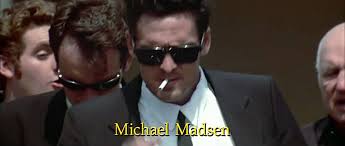
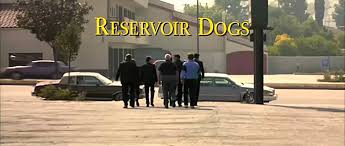
  • Characters are presented through the actor's name and then the name of the character that the actor is portraying followed by the title of the movie "Reservoir Dogs" as it scrolls up.

  • Also, during the torture scene the camera pans away and then pans back to make the audience do the work and create a visual image or paint a picture of the impact of the pain that Mr. Blonde is inflicting on the police officer.


____________________________________________________________________


Enemy of the State

Codes and Conventions:
  • Animal behaviour foreshadows bad events about to happen such as a dog whining.
  • Formal outfits such as suits and ties suggest the characters serve somebody or are somebody of a high stature such as high ranking police or secret agents.
  • Things like sunglasses or masks used to make the face unrecognisable and make person anonymous.
  • Non-diegetic music goes from more calm tone to suspenseful to set atmosphere for scene about to happen.
  • Weather can be used to set atmosphere as well, for example if it is raining, the mood will be more dark and mysterious.

  • Some ways that these codes and conventions can be used in our film are, on the day of his hearing, it can be raining out side to give the impression that something bad will happen, in that example, the suspenseful music can also be used to reinforce the mood as the main character enters, or clears his name, or blames the murder one somebody else.
One way that the movie 'Enemy of the State' links in with ours is the idea of an innocent man getting caught up in a life of crime, or drugs, in this case he's had evidence (video of a murder that could put a politician in jail) planted on him, and his life was then destroyed piece by piece (in this case, his wife is gone and he no longer has his job).

In our case, our main character walks into an apartment with a dead body in it and it is assumed that he was the murderer, he then has a short amount of time to prove that he's innocent.

____________________________________________________________________

Pulp Fiction

Codes and Conventions:

  • As soon as the film opens, criminal couple Ringo and Honey Bunny pull out weapons (pistols) and prepare to rob the diner they're currently eating at. Simply shows that the rest of the film will most likely involve criminal activity mirroring the "Crime" genre.
  • During the start of the film supposed "gangsters" Jules and Vincent pull out of a car and take shotguns from the trunk and enter a building, this quite clearly suggest that they're going inside to perhaps rob someone or commit homocide. They perform this while wearing suits which was also seen in "Reservoir Dogs" to show professionalism and class while on the job. This is a common stereotype seen within gangsters. All this again shows how easy it is to identify the film with the "Crime" genre. The gangsters then go on to murder two people.
  • Again foul language is seen to show a low rent lifestyle and to present themselves as informal.
  • The gangsters have a mob boss "Marcellus Wallace" of who they report to and who commands them to do as he demands, this will usually involve criminal activity. Within the "Crime" genre a boss higher than all others who possesses most authority can sometimes be seen e.g. Don Corleone in The Godfather.
  • Film generally involves criminal activity through violence along with many people either dying or being severely injured (the Diner robbers, the gangsters murdering three people in total, boxer ignoring Wallace's demands about making the match rigged.

Interesting Elements:
  • Film finds a way to be humorous towards audience without identifying itself within the "Comedy" genre through heavy use of foul language / swearing.
  • Film is not shown in chronological order but in fact begins and ends with the ending. Could potentially be a way to make the audience think about the story thoroughly.
  • Begins with the definition for "Pulp Fiction"
  • Begins with groovy / enjoyable music (Jungle Boogie by Kool and the Gang)

Sunday, 16 November 2014

Love Thy Neighbour (Season 2, Episode 1 - The House-warming Party) - Does it challenge or reinforce stereotypes?

After watching the first episode of the second season of the show "Love Thy Neighbour" I was easily able to comprehend that this show simply just reinforces stereotypes (in this case predominantly about black people in this episode). In fact I don't believe I came across any examples of where it challenges a stereotype, mainly just reinforcements of stereotypes.

For example, in instance one of the characters say "Bill was al right for a blackie." when the main character is forcing the black character Bill to leave town. By saying this, the show suggests that the majority of black people are generally seen in a negative light and that it's very rare to see one that is of good company. Before getting to know his personality, they're practically automatically assuming that they're not going to like him due to the colour of his skin. This reinforces the stereotype that black people are generally disliked due to the shows clear racism - which can be seen as the the main white character calls black people "nig nogs" and the main black character calls white people "honkeys".

You could also suggest that since the show was filmed in 1972 (a time where racism was a bigger issue than it is nowadays) it reinforces the stereotype of how English people like to discriminate against people who didn't originate from England. For example, this can be seen when the main character is telling his wife of how they (black people) should return to Africa because they'll feel more comfortable around their own kind as if it's where they belong and suggests that "white culture" is about "Fish & Chips, Coronation Street, Man United etc.). This is also seen when the main character is discussing with his two friends at the pub and refers to it as a "colour problem" due to the fact that the white and black characters a lot of the time like to base their judgement on another's colour of skin.


Friday, 14 November 2014

Fact File on a UK Production Company that created a movie I know

 
Film4 / Channel Four Films
(Created Trainspotting)
 
 
1. Film4-backed films have received a total of 27 nominations at this year’s British Independent Film Awards (BIFAs). Yann Demange’s ’71 received 9 nominations, the highest number of all films on the list.
 
2. Film4 Productions is a British film production company owned by Channel Four Television Corporation. The company has been responsible for backing a large number of films made in the United Kingdom.
 
3. The company's first production was Walter, directed by Stephen Frears, which was released in 1982.
 
4. Prior to 1998, the company was identified as Channel Four Films or FilmFour International. Later, the outfit was re-branded as FilmFour, to coincide with the launch of a new Digital TV channel of the same name.
 
5. The company cut its budget and staff significantly in 2002, due to mounting losses, and was re-integrated into the drama department of Channel 4.

Tuesday, 14 October 2014

City of God - Edits

A graphic match cut is showing a musical instrument mirroring a blade to show that violence is key to their life just as much as music is.

Flash frame of knife being scraped off of a rock using hyperbolic sound suggests that the movie is quite clearly going to contain violence and that the characters will obviously encounter some violence. Also indicates that death is going to occur.

Camera flash mirrors sunlight again by using a graphic match cut to show that the sunlight is just as important to him as the camera is as if sunlight is the root out of this poor lifestyle.

Immediately cuts to a dark, blue image to show the state of his current situation – a moody, dangerous world with no hope. Then cuts to him behind bars of some sort to show that he is imprisoned and may never escape the lifestyle he currently lives.

POV shots (from the chicken’s perspective) are used in various shots to almost show that the chicken is aware of what’s going around it due to its facial reactions from seeing other dead chickens being prepared as food along with many knives being used. The chicken practically mirrors the main character Rocket’s situation to how dangerous life is where they are currently living and how they both find it very hard to escape. This is also achieved through shot – reverse shots to show that the chicken is in some way able to communicate with its surroundings.

Gladiator (Ridley Scott, 2004)

Gladiator (Ridley Scott, 2004)

The close up of his hand shows us he's married as it fixates on a ring on his hand. The fact that the shot is in a warm colour in comparison to the cold blue of the battle suggests it is a flashback or a dream sequence of a place he would rather be. This is evidenced by the cut to a medium close up of him lost in thought. The sound of a woman humming and the noise of children playing (non diegetic sound) suggests he misses his family. As we move to the battlefield a guitar strum is heard which quicker the pace indicating the fight is about to begin. The shot reverse shot between him and the robin not only suggests it is a cold bleak landscape but also signifies his desire to escape back home to warmer climes. The use of a crane shot allows us to see the size of the Roman troops. The low angle shot of Marcus Aurelius in combination with the gold chain and the dark blue cloak indicates he is the Emperor. The use of a tracking POV shot permits the audience to see the man from his perspective. They bow down before him and greet him warmly indicating he is a well respected and liked officer. The dialogue in which he says "Range is good." indicates he is confident with battle strategy.

Friday, 3 October 2014

Shot techniques used in Reservoir Dogs


Shot Reverse Shot

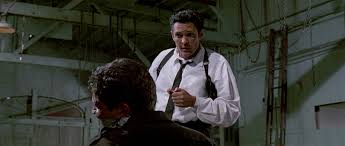
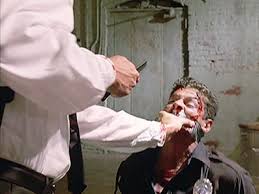
The Shot Reverse Shot camera technique is commonly used in this scene where the camera angle keeps switching from Mr Blonde's actions to the officer's facial expression in order for the director to place you in a position where you're able to see the clear sense of fear that is shown from the police officer.
Match On Action

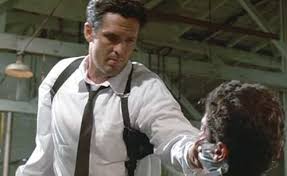
A Match On Action shot is used within this sequence as we see the character Mr Blonde attack the officer as we see the camera cut to his hand as he attacks him. This simply just reinforces the violence and craziness that we have already seen from Mr Blonde, again clearly showing that he has psychopathic tendencies.
Camera Panning Away

During the torture scene where Mr Blonde cuts off the officer's ear the camera pans away to an empty space and then returns. It does this to make the viewer create a more brutal and vivid image inside their heads and ask the questions such as "What could he possibly be doing to him?". When the director Quentin Tarantino does this he essentially making the viewer do the work on their own as the mind is more evil than the film sequence.

Tracking Shot/Close Up

The Tracking Shot is also used in this sequence in addition to a Close Up which is commonly used to show the emotion a character feels which can be conveyed from their facial expression, in this case fear. The tracking in this case is used to lead you into thinking that the police officer is about to be tortured, something the character also himself feels within the scene.